
When Smart Teams Make Bad Decisions
How cognitive biases quietly undermine your judgement—and what leaders can do to fix it.

Did you know that there are over 180 ways to make wrong decisions?
Ongoing research continues to discover and define new ways humans make mental mistakes, because cognitive biases are at work whenever we make decisions.
A cognitive bias is a systematic error in thinking that occurs when we process and interpret information in our environment. It affects the decisions and judgements we make, leading to the extrapolation of information from incorrect sources, the confirmation of existing beliefs, or the failure to recall events as they actually occurred. You’ve likely heard of these biases. They include: groupthink, self-interest bias, confirmation bias, anchoring bias, and almost 200 others.
The best summary I have discovered is by Marcus Lu, which I recommend you print out and bookmark. As his summary indicates, four types of problems trigger these biases.
Trigger One – problems involving information overload,
Trigger Two – lack of meaning,
Trigger Three – the need to act fast, and
Trigger Four – how to know what needs to be remembered for later.
Our brains and emotions continually trigger these biases. This is true for every member of your team. In fact, the team unit often amplifies its impact on collective decision-making. Perhaps because teams tend to look for external reasons or causes to assign blame and justify why things didn’t end up as expected, an example of self-serving bias - we don’t have enough people, timelines are unrealistic, team abc didn’t finish on time, etc.
You therefore need to be mindful of how these cognitive biases affect your team, especially since execution speed is essential, given that the time horizon for most decisions is limited to hours, days, and weeks. Decision-making frameworks will help you manage the problems that trigger biases, shape how you, as a team, debate, decide, and agree, and ultimately make better decisions.
First, recognise that not all decisions are equal. Therefore, using a heuristic to facilitate problem-solving and decision-making can be helpful:
Is this problem or opportunity significant enough to require a robust framework and additional information and perspectives? These are “Type 1” decisions.
Is my informed intuition, judgement and experience sufficient to make the decision quickly? These are “Type 2” decisions.
The following provides a more detailed description of these two types of decision.
Type 1 decisions – consequential and irreversible
These are often referred to as “one-way door” decisions. Think of these as Decisions, with a big “D”. Once made, they’re usually fixed and inflexible. For Type 1 decisions, which are those that are more consequential and irreversible, the emphasis should be shifted to processes that elevate decision quality. Robust decision-making frameworks, sources of feedback, and diverse points of view are essential for reducing the risk of poor decisions. These decisions can alter the trajectory of our careers.
Type 2 decisions – inconsequential and reversible
Contrast Type 1 decisions with decisions of lesser consequence and that are reversible. These are the “revolving door” decisions or decisions with a small “d”. There’s little impact on your life if the original outcome differs from what you want. You don’t have to live with the results. You can change your mind relatively quickly and with little impact if the original outcome isn’t quite what you want.
The pitfall many teams face is allocating too much time and energy to type 2 decisions, which they should make quickly with the available information, or failing to use robust frameworks to combat cognitive biases that affect the quality of type 1 decisions.
Below, I am sharing my favourite ones. Chosen for their simplicity, speed of use and effectiveness at combating biases. I have used all of them throughout my career in financial services and, more recently, with my coaching clients.
Decision Quality Control Checklist - Daniel Kahneman, Dan Lovallo, Olivier Sibony
To help team leaders vet decisions, the authors developed a checklist intended to unearth defects in a team’s thinking. Use the twelve questions, split into three categories, to expose and mitigate the cognitive biases at work:
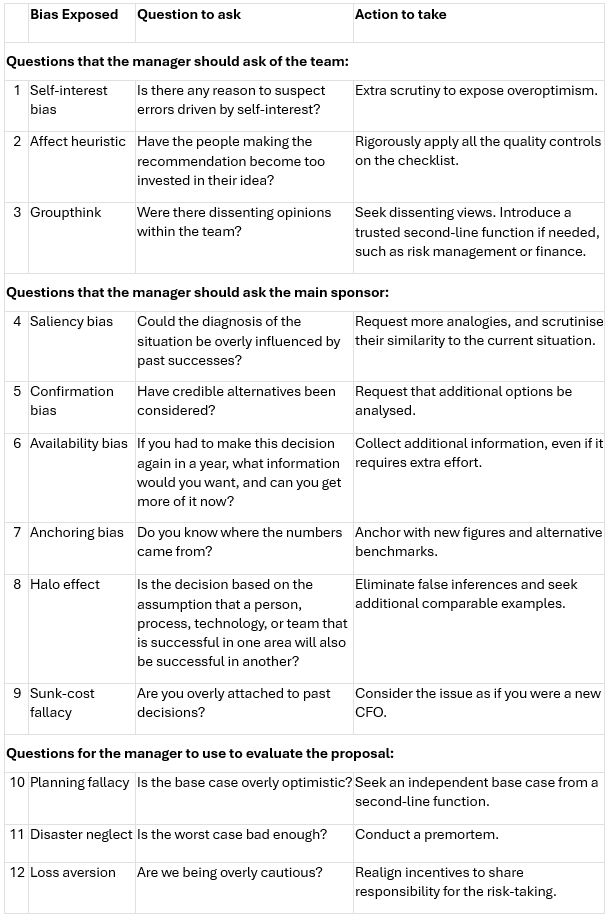
As with all these frameworks, managers need to realise that a disciplined process, not individual genius, is the key to better Type 1 decision-making.
Premortems - Gary Kline
The best way to recover from a false start is to avoid it in the first place. A powerful technique for doing that is a premortem. A premortem, the brainchild of psychologist Gary Klein, is an effective method for improving decision quality. For the current type 1 decision, ask your team the following:
“Assume it’s twelve months from now, and our project is a complete disaster. What went wrong?”
The task is to generate plausible reasons for the failure. By anticipating failure and understanding the causes of the false start, you can better anticipate and avoid potential problems.
A typical premortem begins after the team has been briefed on the plan. As the facilitator, you begin the exercise by informing everyone that their work has failed spectacularly. Over the next few minutes, each team member independently writes down every reason they can think of for the failure, especially the kinds of things they ordinarily wouldn’t mention as potential problems, for fear of being impolitic.
Next, ask each team member to read one reason from their list. Everyone offers a different reason until there are no more ideas left. At this point, the list is reviewed, and mitigation plans are put in place to improve the chances of success.
Six Thinking Hats - Edward de Bono
With the Six Hats method, the emphasis is on what can be rather than what is, and on how the team can design a way forward, rather than on who is right or wrong. It is a structured technique for exploring different perspectives in problem-solving and decision-making, using six coloured “hats” as metaphors for specific modes of thinking.
White Hat: Focuses on facts and information. This hat involves gathering data and evidence and identifying what is known and what needs to be known, without emotion or opinion.
Red Hat: Represents feelings and emotions. This hat encourages the expression of intuition, gut reactions, and emotional responses to ideas without requiring justification.
Black Hat: Highlights caution and critical judgement. The focus is on potential problems, difficulties, risks, and identifying what could go wrong with an idea or plan.
Yellow Hat: Emphasises optimism and positive thinking. This hat seeks opportunities, benefits, and values of ideas, actively looking for the positive aspects.
Green Hat: Symbolises creativity and new ideas. When wearing this hat, participants are encouraged to think outside the box, propose alternatives, and generate innovative solutions.
Blue Hat: Concerns process control and organisation. Usually worn by the facilitator, the blue hat manages the discussion, sets the agenda, and ensures guidelines are followed.
The Six Thinking Hats method enables a group to systematically explore a topic from all viewpoints, one mode at a time, minimising confusion and conflict. Participants “wear” only one thinking hat at a time, which encourages focused discussion. The technique is used in both individual and group settings to improve decision quality by isolating ego and argument, enabling more objective exploration of ideas.
Here are some final thoughts on how your team debates, decides and agrees on the way forward:
Some decisions are exclusively yours. Particularly those crucial decisions that impact people, such as hiring, firing, and setting the team up for success.
A manager’s job is to lead a decision-making process that ensures all perspectives are heard and considered, and, when necessary, to break ties, make a decision, and then get people to disagree and commit. Dissent is important; your goal should not be to achieve unanimous decisions all the time.
It is okay to change your mind. In fact, it is an obligation when faced with new information.
Suppose you plan to overturn a team decision. In that case, it must be conducted in the appropriate setting with the same group of participants. Leaders who unilaterally change decisions after bilateral conversations in side corridors or after being lobbied by interested parties damage trust and weaken team members’ commitment.
Don’t brainstorm cold. If you are going to brainstorm as a team, it is your responsibility to provide all necessary information in advance and to give the team time to think and assess independently before meeting.
Focus on the causes, not the symptoms, to save your team time in the future. Good decisions, made well, make problems go away and the future easier. People may not even realise you made the decision because you made a problem go away (before it became one).
Don’t devote a disproportionate amount of your team’s time to trivial matters (type 2) at the expense of important decisions (type 1).
Never assume that a team member’s silence on a matter constitutes implicit agreement. Always aim to make the implicit explicit.